How we work
Three steps. No discovery theatre.
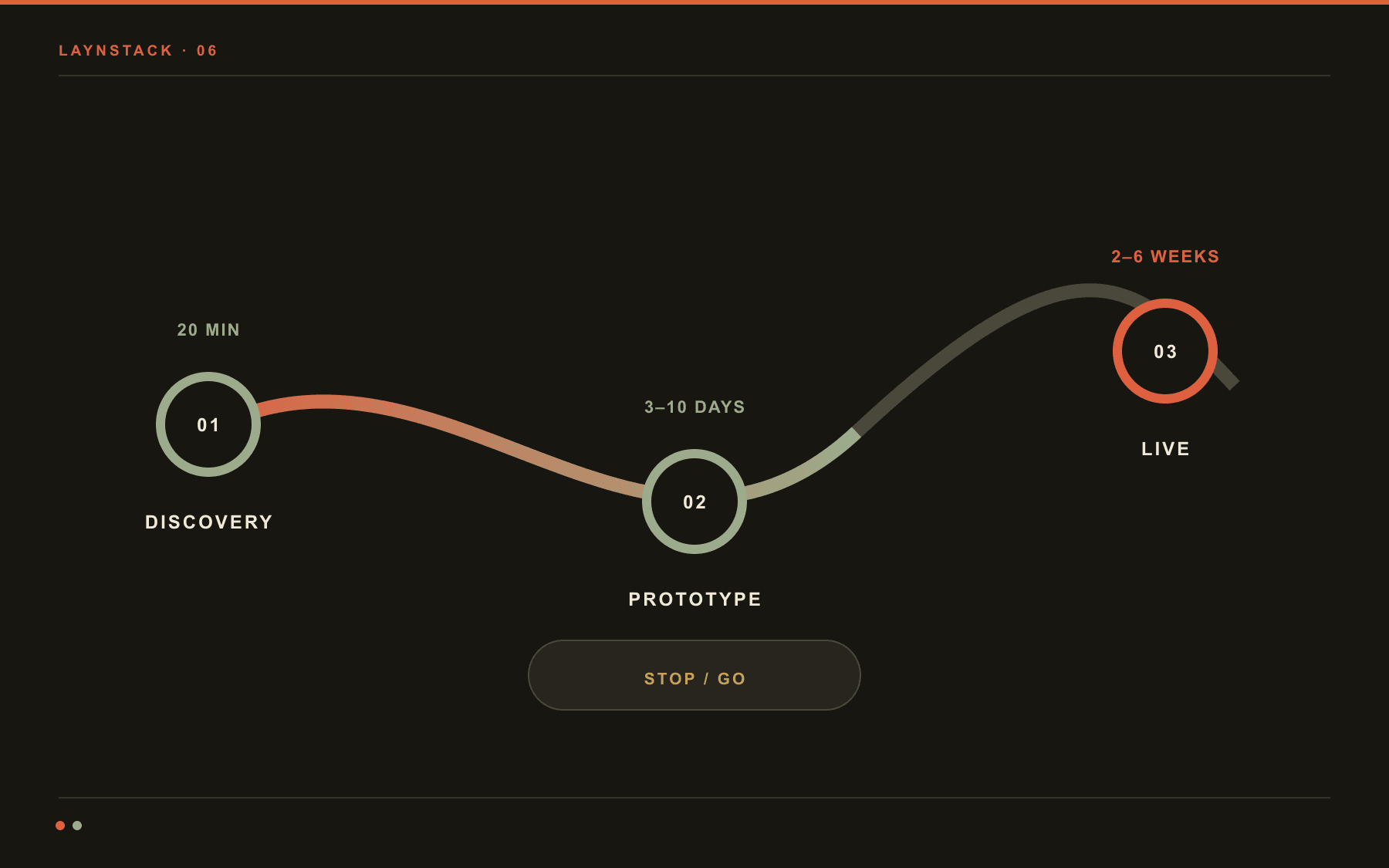
Every engagement runs the same short arc: a twenty-minute conversation, a working prototype, then production. You can stop after any step, and everything built up to that point stays with you.
No phase exists only to justify the next invoice. If a step does nothing concrete for you, we skip it – or we never start it.
- Discovery
- Free
- Prototype
- Days, not months
- Pricing
- Phased
The process, stripped
- 3
- Gates you can stop atThe decision is yours at the end of each phase.
- 0invoices
- For discoveryThe first call and the scope note cost nothing.
- 20min
- Commitment up frontThat is all we ask of your calendar to begin.
- 2–6weeks
- To productionTypical time for a first system to go live.
Three phases, one calendar page.
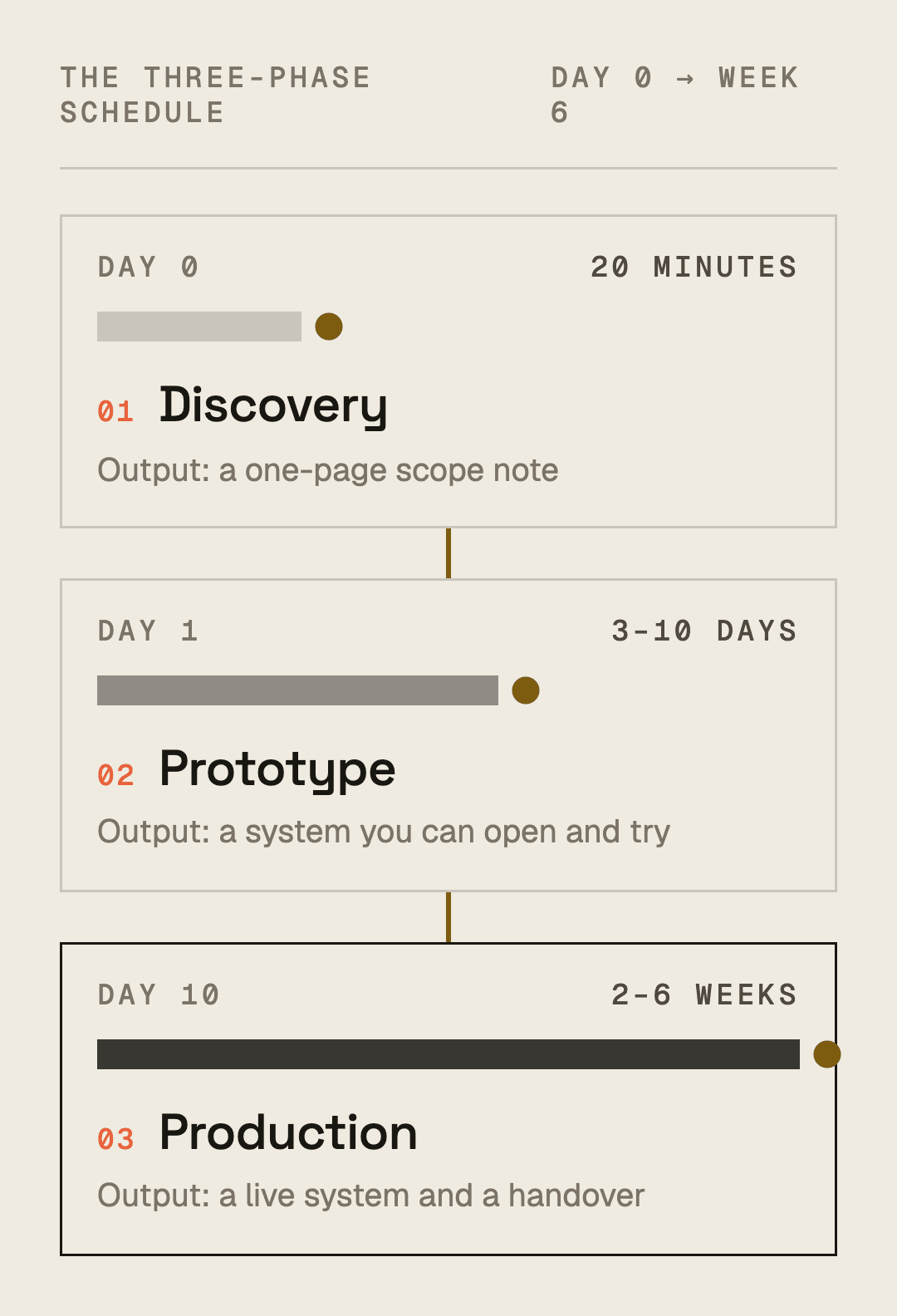
The figure below is the calendar of a real engagement. Widths roughly track duration: the conversation is a lunch break, the prototype a handful of days, production a few weeks. The dots mark where you can get off.
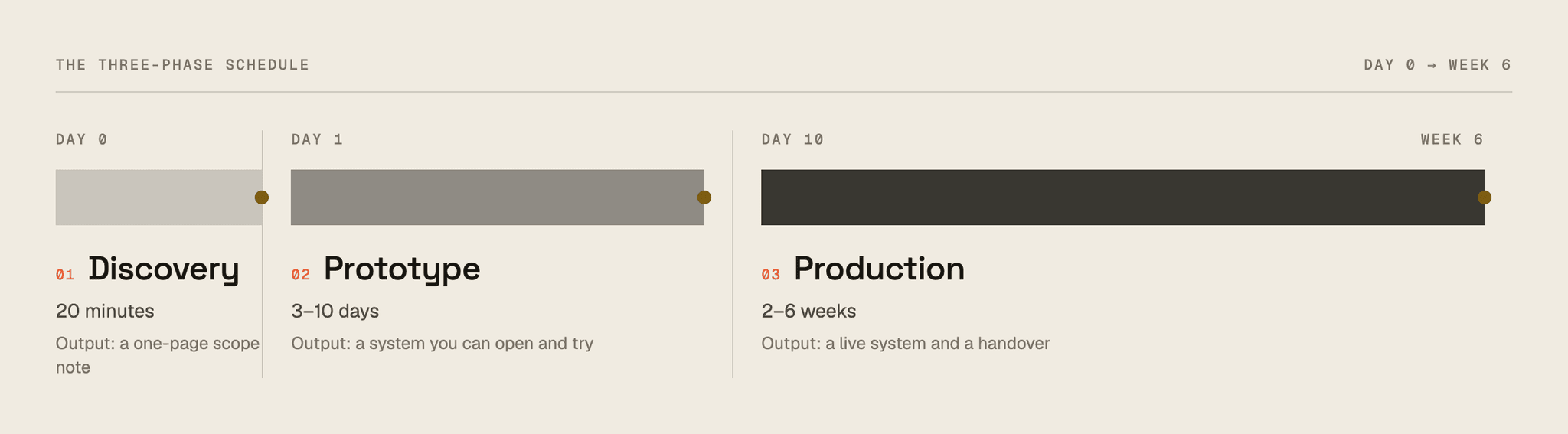
the calendar of the three phases
- Gate – you can end it here
- Day 0 is the day of the first call.
- Durations are for the first release of a single system.
Twenty minutes and one question.
There is no salesperson on the call; you speak directly with the technical team that would do the work. You share your screen and show where the work jams, and we tell you whether AI is the right tool here.
- Duration
- 20 minutes
- Format
- Video call
- Fee
- None
What happens
- You walk us through the work end to end. We take notes; no deck gets opened.
- We follow one real artefact: a document, an email thread or a short screen recording.
- We separate the parts that need human judgement from the parts a plain rule can settle.
- Within one working day we write you a one-page scope note.
What we ask of you
- The person who actually does the work on the call.
- One real example: an invoice, an email, a form. Anonymised is fine.
- A rough answer to how many people do this, and how often per day.
What you walk away with
- A one-page scope note: the problem, the proposed route, a duration and a price range.
- A plain paragraph saying so if AI is not needed here.
- No obligation, no invoice, no follow-up calls.
You can stop here
The scope note is yours. Hand it to your own team, or to another studio. You never have to hear from us again.
Not a slide. Something you can open.
A short fixed-price build. At the end there is a narrow system running on your own data with a real interface. The point is not to impress you; it is to learn whether the thing actually holds.
- Duration
- 3–10 days
- Price
- Fixed, agreed up front
- Data
- Your own samples
What happens
- We build one job end to end: the one that repeats most often.
- It runs on your sample data. We do not use canned demo data.
- You get a link and try it yourself in a browser.
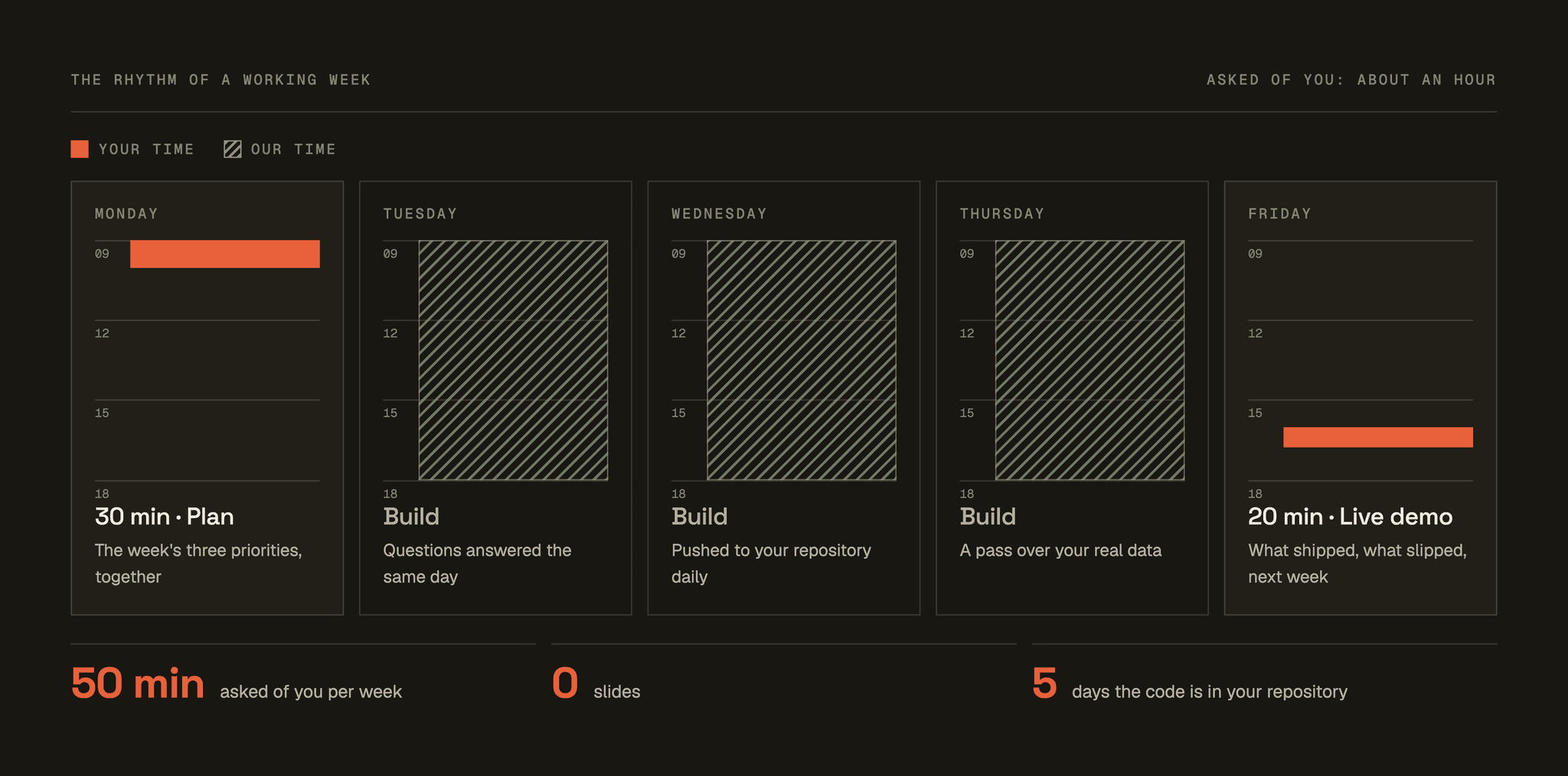
- Two short video check-ins a week. Nothing written in between.
- We measure where it gets things wrong and show you the number as it is.
What we ask of you
- Twenty to fifty real examples: documents, records or messages.
- One person who knows what the right answer looks like; an hour a week is enough.
- Read access where it is needed. We do not ask for write access in this phase.
What you walk away with
- The working prototype and its source, pushed to your own repository.
- An accuracy measurement: how often it is right, and where it slips.
- A production quote based on measurements rather than guesswork.
You can stop here
If the prototype does not do what you hoped, the work ends there. The fixed price stays fixed, no further invoice appears, and the code and measurements stay with you.
Wiring it into the daily work.
This phase moves the prototype to where the real users, the real volume and the real failures are. Access control, logging, monitoring and handover all happen here.
- Duration
- 2–6 weeks
- Price
- Quoted after the prototype
- Hosting
- Your cloud or ours
What happens
- Access, roles and logging go in, so who did what stays visible.
- The system is installed on your infrastructure, and the data stays in the country you chose.
- Monitoring and alerts are set up, so when something breaks we usually see it first.
- A two-hour handover: how it works, where to look, when to email us.
What we ask of you
- One system owner, and one contact on the IT side.
- A small group of users willing to run real work through it for two weeks.
- The accounts, domain and server access the install needs.
What you walk away with
- The running system, its source and its install scripts, all registered in your name.
- A written handover document and a one-page architecture drawing.
- Monthly maintenance if you want it, and a system that stands without us if you don't.
You can stop here
After handover you are not tied to us. A maintenance agreement is optional, billed monthly, and you can end it in any month.
What leaves with the project.
None of this is an extra. All eight are part of the build, written into the delivery list, and never invoiced separately. They stay with you on the day you stop working with us.
01
Source code in a repository you own
The code lives in your account from the first commit; we are contributors to it. Setup steps are documented, so another team could have it running in a day.
02
An evaluation set built from your real cases
Hundreds of examples from your own archive, each with the answer it should have produced. After a change you find out what broke by running one command, not by arguing about it.
03
EU / Türkiye hosting
Where the servers sit and which processor handles which step, written out by name.
04
Monitoring that speaks up
Error rate, latency and cost are measured continuously; when a threshold is crossed you are told, not left to check a dashboard.
05
Access control and audit trail
Who reached what, and which record changed when and on whose authority, traceable after the fact.
06
Documentation and a runbook
How the system works, and what to do when it breaks at three in the morning. Both written, both short.
07
An exception path
A defined human route for every case the system is unsure about: who it reaches, how long it waits, how it closes.
08
A direct line to the technical team
No account manager in between. You write to the team that wrote the code, and the reply comes from them.
Eight items, the same on every project.
We price what we already know.
The three phases carry three separate arrangements, and none of them is a deposit on the next. Discovery is free, the prototype is fixed-price, and production is quoted only once the prototype is done – before that we would be guessing.
What you know and what you are committed to rise together.
Discovery
Nothing to sign. The output is a scope note.
Prototype
One figure for one job, written down before it starts.
Production
Priced only once the measurements are in hand.
Phase
Payment
When it is settled
Discovery
Free
Before any contract
The call, the scope note, and an honest “you don't need this” if that is the answer. There is nothing to sign.
Prototype
Fixed price
In writing before we start
One number for the one job in the scope note. If the scope grows we talk first; the number never grows on its own.
Production
Quoted after the prototype
Once we hold the measurements
We quote after seeing how much work is left on real data. Fixed price or weekly rate – the choice is yours.
True in every phase
The source is yours
We write into your repository from day one. No locked platform, no licence fee.
Skipping a phase is allowed
If your own team built the prototype, we can start at production. Nobody has to begin from scratch.
Maintenance is optional
Monthly and fixed. Plenty of clients run on without it after the handover.
What we don't do: sell per-seat licences, bill open-ended consulting days, or stretch discovery to justify the next invoice.
The questions every call brings.
These are not invented. They are the five things people ask us most often in the first twenty minutes, and the answers we give.
Two to six weeks for a typical first system. The prototype takes three to ten days; production depends on how fast data access and internal approvals arrive. Most delays come from waiting on a permission, not from code – we say so at the start.
The work ends there. The fixed price stays fixed and no extra invoice arrives. The code, the measurements and a short note on what failed and why stay with you. That outcome is not rare, and it is cheap: far cheaper than building the wrong thing for a year.
The same people from us, start to finish. Three roles from you is enough: someone who does the work, someone who can decide on budget, and someone in IT who can open access. In smaller companies one person often covers all three.
No. Twenty to fifty examples are enough, and they can be anonymised. If needed we build the prototype entirely inside your environment, and you get one written page saying what data goes where.
Usually yes, but for a narrower slice. When a team exists we tend to prototype the risky part and hand it over with the measurements, and your engineers build the rest. In that case you never buy the production phase at all.
Next step
Let's talk about what to build, or what to automate.
A free twenty-minute call. You will be talking directly to the technical team doing the work, not a salesperson. Bring a site, a dashboard, or a task your team repeats every week – if it is not worth building, we say so.
- Free · 20 minutes
- Directly with the technical team
- Reply within 1 working day