

Skip to content
laynstack

Software and automation studio – Ankara · Remote

From dashboard to automation, one team.

Laynstack is a software studio in Ankara. We build the software a business runs on: a website, a customer dashboard, an internal system that carries one workflow end to end. Once it is live, the repetitive work inside it becomes ours too.

  • 20 minutes · free
  • You own the code
  • Architecture designed for KVKK and GDPR
  • runs in the system
  • the call a person keeps
Base
Ankara
Working
Remote
First prototype
Days
Data
GDPR & KVKK
Scroll

What we commit to before you commit to anything

How a project runs
20min
Free discovery callNo deck. You talk directly to the technical team.
3–5days
To a working prototypeA real version you can try on your own data.
2–6weeks
To productionWe cut the scope to fit that window instead of letting it drift.
100%
Code ownershipRepository, servers and documentation in your name from day one.
1day
Reply timeEvery message you send gets an answer within one working day.

Who we work with

We take on a few projects at a time.

Tourism, health, manufacturing and the non-profit sector. What they share is not an industry: it is needing a system their work actually runs on.

  • Duyoo logo
  • DigitalTR logo
  • ADN Araç Dizayn logo
  • Eşit Nesiller Derneği logo
  • Patec Group logo
  • Conais logo

We do not take on more projects to make this list longer; a name lands here once the work ships.

01Inside the system

Repetitive work piles up inside the system we build.

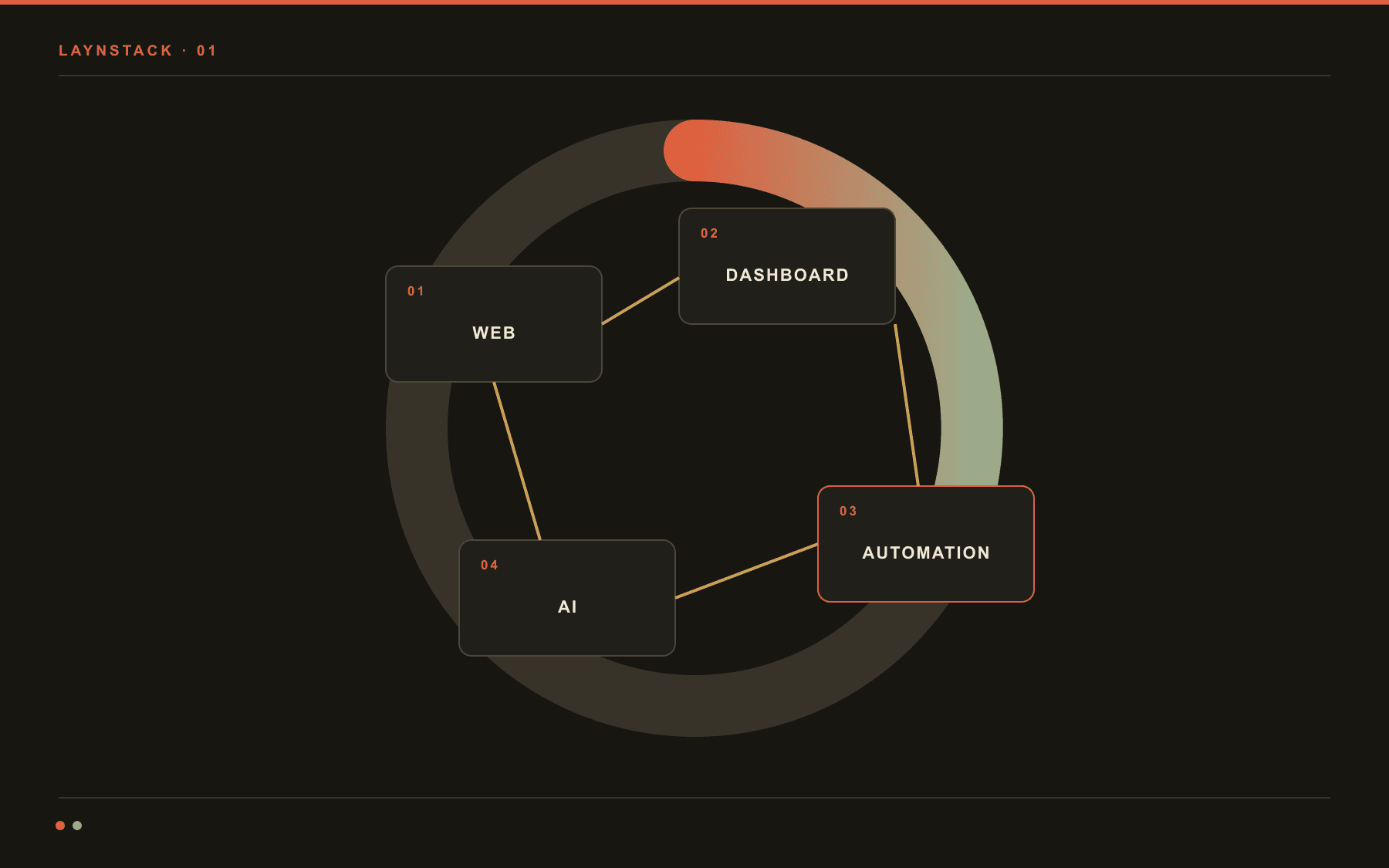
Diagram showing a website, customer dashboard, process automation and AI integration connected within one system.
web, dashboard, automation and AI in one system
Open full size

A company's daily work usually runs on three or four systems: the website, the dashboards its team and its customers type into, and the internal system that carries an order from one end to the other.

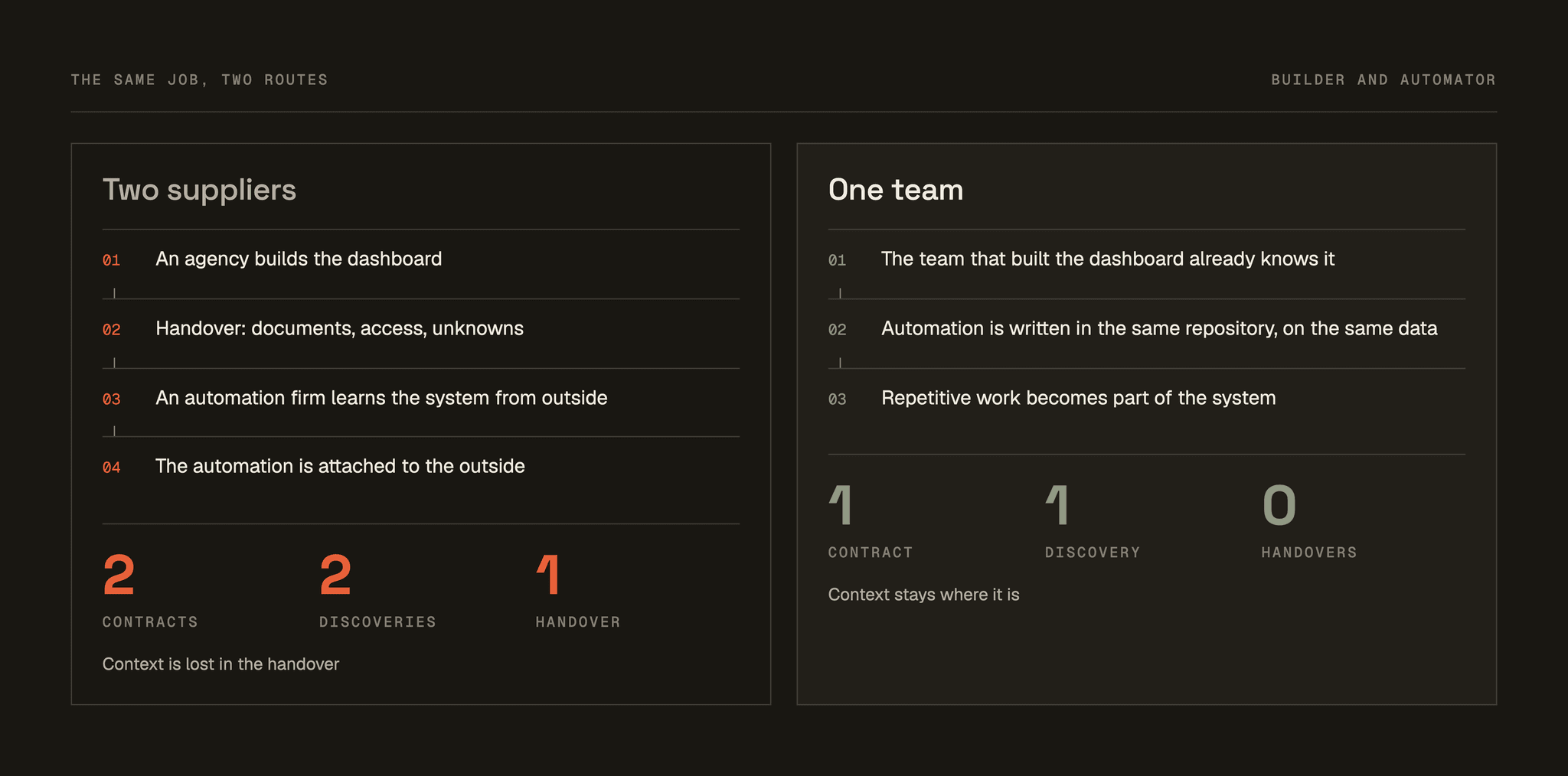
We build those systems, so we also see what gets re-keyed by hand every week. Normally this takes two suppliers: an agency builds the dashboard and somebody else bolts the automation on later. Laynstack does both with one team.

Invoices, delivery notes and forms land in the system; somebody opens each one, reads it and re-types the fields into the dashboard.

usually the fastest thing to pay for itself

The same questions come back every week, and the answer already written down in the system gets typed out by hand anyway.

same answer, a third of the wait

Records carried by hand from one system into another, and the same spreadsheet rebuilt from scratch every month.

the copy-paste hours come back

Month-end means lining the number on the dashboard up against two other sources and walking backwards until the gap explains itself.

the gap shows up same day, not three days later

The rule is defined nowhere in the software; one person carries it, and the work stalls the week they take leave.

annual leave stops being a risk

Two routes to the same job side by side: with two suppliers, an agency, a handover and automation attached from outside; with one team, automation written by the team that built the dashboard, in the same repository. Two contracts and one handover against one contract and none.
the same job, one team instead of two suppliers
Open full size

where the time goes in one recurring task inside that system

The same task, before and after one setup.

Today100% human time
  • Queueing20%
  • Reading and checking26%
  • Re-keying24%
  • Chasing a mismatch18%
  • Filing12%
After one setupleft to a person: 12%
  • Runs without a person88%
  • One call12%
  • Human time
  • Runs without a person
  • Judgement stays with a person

The proportions drawn here are illustrative – the shape is the point. We measure the real ones by hand, on your own task, in week one.

02Software first, then automation

Websites, dashboards, internal systems then the repetition inside them.

Laynstack is a custom software studio in Ankara: we build the system a business runs on, then take over the repetitive work inside it. Most engagements start with the first of the three below. We do not do ad management, branding or content.

01

Websites, Dashboards and Internal Systems

SpreadsheetEmailWhatsAppShared folderA paper notebook

One system

Interface

Logic

Data

five scattered tools, one internal system

Dashboard, admin panel, back-office screen: names for one thing, the data-backed interface a team or a customer works inside every day. The same team works at all three scales, from a corporate site to an internal system that carries a whole process.
02

Process Automation

  • 37 runs finish without touching anyone
  • 3 runs go to a person on purpose
forty runs in a typical week

Process automation is handing a manually repeated task over to software, end to end. That task usually sits inside the dashboard we built; because the same team writes both, the automation goes inside the flow rather than beside it.

03

AI Integration

A question comes in
Retrieval over your sources
Answer with citations
No source, no answer
grounded answer flow

AI integration means putting a language model on top of your own data. The assistant answers from your documents, shows which one each answer came from, and returns nothing when there is no source.

03Automation architecture

The automation inside the system is a line, not a model.

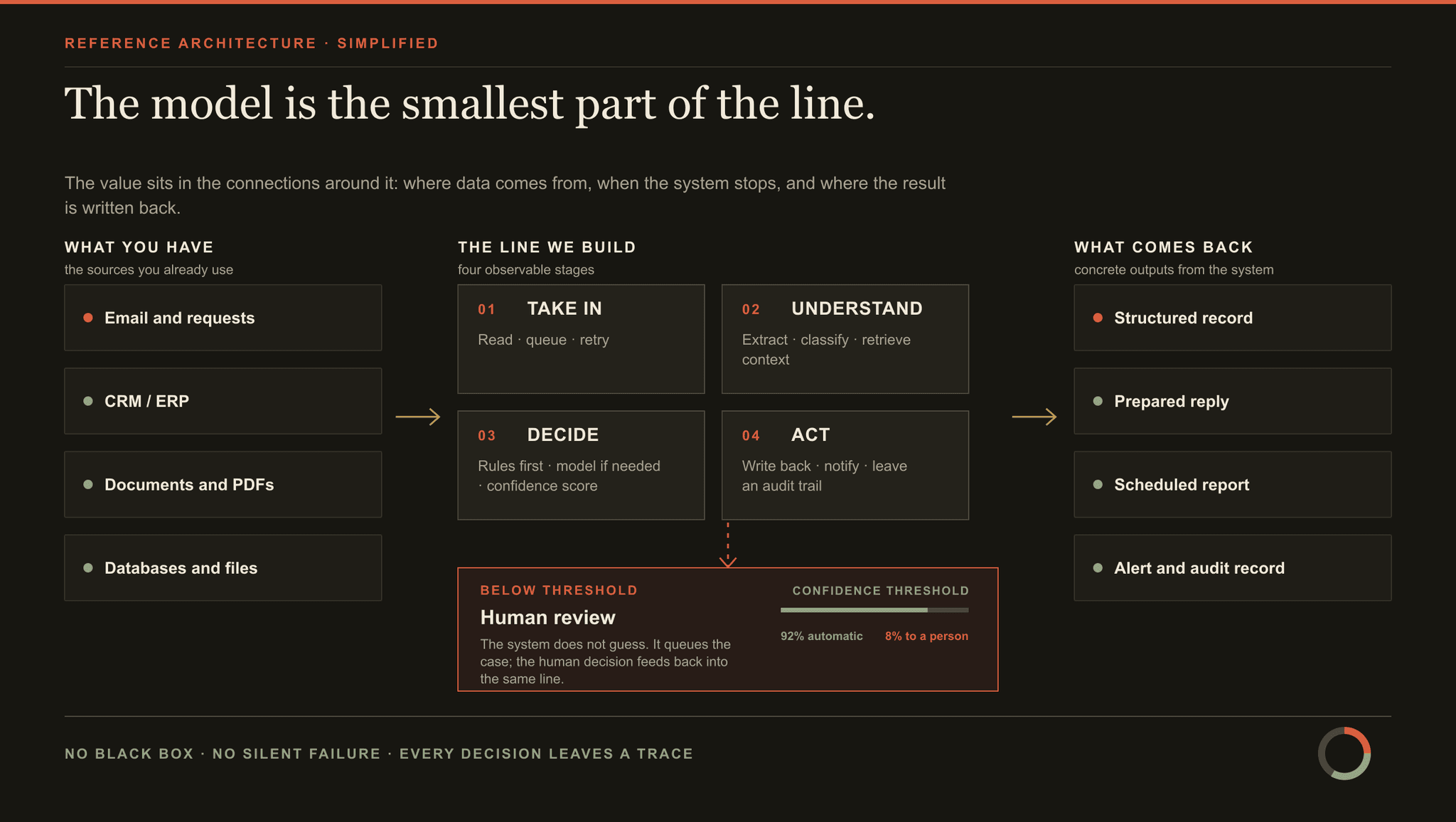
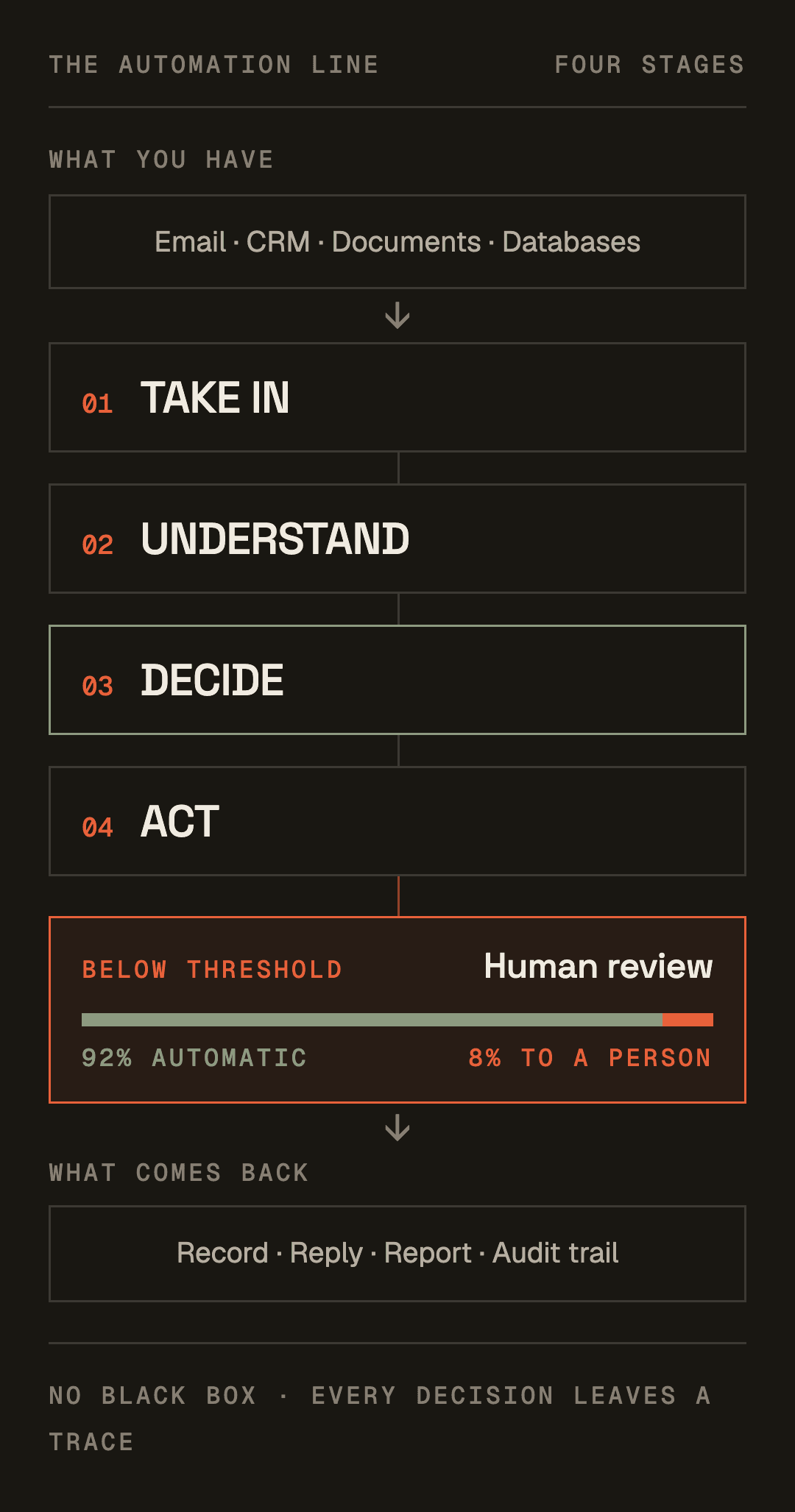
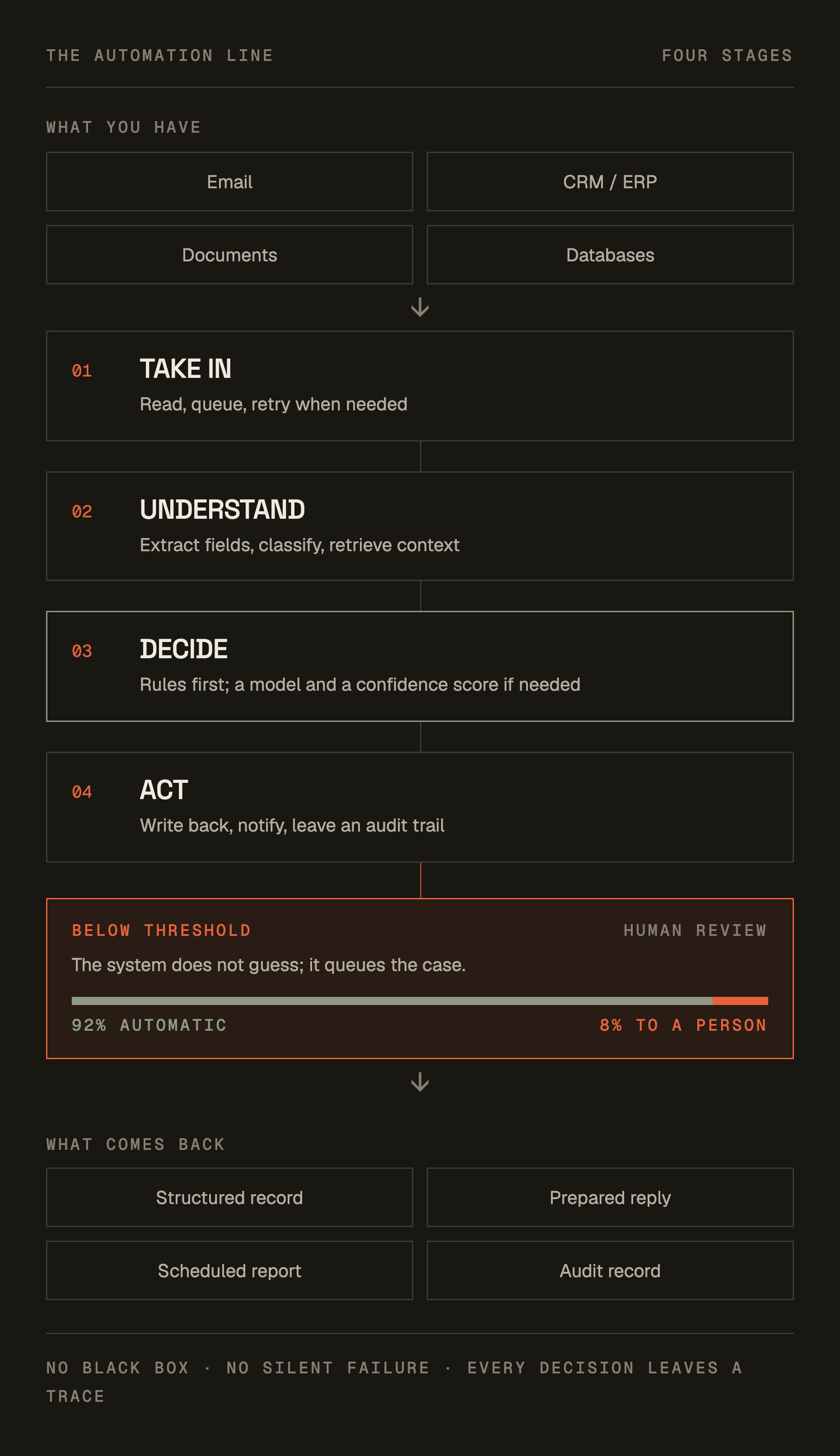
Once the dashboard is live, the repetitive work inside it moves onto a line like this one. The model is its smallest part; the work sits on either side of it. Where the data comes from, when the system asks a person, where the result is written back.

The automation line simplified for a phone: inputs, the take in, understand, decide and act stages, then human review for cases below the confidence threshold.
the automation line: inputs, four stages, human review
Open full size

01

No step is a black box

Next to every decision sits the rule that fired and the line of the document it was read from. When you question an output, you open it and look.

02

Designed around the exception

The system is built for the hard minority, not the easy majority. Every tool handles the easy part; what separates them is how the remaining cases are treated.

92% automatic8% to a person

03

It fails loudly, not quietly

When a connection drops or an input arrives in an unexpected shape, the job stops and somebody hears about it. Stopping is always cheaper than quietly writing the wrong data.

04How we work

From a twenty-minute conversation to a system in production.

Three steps, with durations you know in advance. Each one ends with something concrete in your hands, and if you decide to stop there, it stays yours.

01 · 20 minutes
02 · 3–5 days
03 · 2–6 weeks
Day 0Week 3Week 6

typical schedule; what stretches it is usually access, not engineering

0120 minutes

Discovery

You describe the work; we tell you whether this is the right tool.

023–5 days

Prototype

A narrow first version running on your own data, open in a browser.

032–6 weeks

Rollout and scale

The prototype, rebuilt to stay standing under real load.

The result

What you hold at the end of step three.

Code
The repository is in your account from day one, with the setup steps written down.
Infrastructure
Servers and accounts are opened in your name, in the EU or in Türkiye.
Documentation
How the system works and what to do when it breaks, both written down.
Training and handover
A two-hour handover for your team; after it you are not tied to us.

None of it is an extra; all of it is on the delivery list.

KVKK and the AI Act

Compliance is a design decision, not a certificate collected afterwards.

Personal data is set up to meet KVKK from the first commit. Where a system contains AI and you also sell into the EU, the same work covers the articles of the EU AI Act, which is in force and phasing in year by year. Neither one is a layer added at the end.

1 Aug 2024
in force, applying in stages
6
duties we build for
6
artefacts at handover
05Questions

What people ask before the first call.

The same seven questions come up every time. The answers live here so the call can be spent on your actual problem.

On a project aimed at one clear task, a working first version is in your hands within 3 to 5 days. Getting it into production usually takes 2 to 6 weeks, depending on how many systems it connects to and how your approvals run.

What stretches the schedule is rarely our workload – it is access being granted and test data arriving. We give you a realistic range on the first call and we do not quote a date we expect to miss.

Yes. We work remotely, and for most projects a weekly video call plus messages during the day is more than enough.

We run the same process with companies elsewhere in Türkiye and abroad, and up to about three hours of time difference nobody notices the distance. If the rollout week needs us on site, we come, and we plan that in from the start.

Price is set together with scope: a range after the discovery call, a fixed number once the prototype is finished. We can fix the second number for a simple reason – by then both of us have seen how big the work really is.

There are no surprise line items later; if the scope changes we talk about it before anything is written. If you already have a budget, say so, and we will usually find a way to cut the scope to fit it.

Your data stays yours. By default processing runs on servers in the EU or Türkiye, and we hand you a written list of which provider is involved at which step.

We do not use your data to train models and we do not pass it to third parties; that is stated plainly in the contract. Where nothing may leave the building at all, we build the system around models that run on your own infrastructure.

Usually yes. Anything with an API we connect to directly; for older software without one we bridge through read access to the database, a scheduled export, or a watched folder.

The only case we cannot reach is a fully closed system with neither an interface nor data access – and we find that out inside the twenty-minute call. Replacing what you already run is never our first suggestion.

We are comfortable saying so. For some problems the right answer is a SQL query, a rules engine, or moving two fields on a form – all of which are cheaper, faster and more predictable.

In discovery we look at how often the work repeats, how structured the data is, and what an error costs; if all three do not line up, we do not propose a model. In that case we either build the ordinary software side or we decline the project.

The team on the call is the team that writes the code. There is no project-manager layer in between, so what you describe reaches the people who build it.

We do not subcontract the build, and if a specialist joins for something like design, we say so while quoting. After handover you still write to the same team.

A card of six commitments: a free 20-minute discovery call, a working prototype in 3–5 days, production in 2–6 weeks, full code ownership, a one-day reply time, no sales layer.What we commit to before you commit to anythinglaynstack.com0120minFree discovery callYou speak directly with the technical team doing the work.023–5daysTo a working prototypeA real version you can try on your own data.032–6weeksTo productionScope is cut to fit this window.04100%Code ownershipRepository and servers in your name from day one.051dayReply timeEvery message answered within a working day.060Sales layerThe team on the call writes the code.
six commitments, all written down on the first call

Next step

Let's talk about what to build, or what to automate.

A free twenty-minute call. You will be talking directly to the technical team doing the work, not a salesperson. Bring a site, a dashboard, or a task your team repeats every week – if it is not worth building, we say so.

  • Free · 20 minutes
  • Directly with the technical team
  • Reply within 1 working day