Data protection and AI compliance
Compliance is designed into the system, not added afterwards.
Before development begins, we define where data is stored, who can access it, what is logged and where human approval is required.
The access, logging and oversight structure that KVKK, GDPR and the EU AI Act expect in technical terms is in place from day one.
- Scope
- KVKK · GDPR · EU AI Act
- Data location
- Türkiye · EU · your own server
The four controls built into every project.
All four are written into the contract and the deployment records. If one of them changes mid-project, the change itself is logged.
- 01Data location
- Türkiye, an EU region or your own server. The location is stated clearly in the contract and deployment records.
- 02Access control
- Each user can access only the data required for their work. Permissions are role-based and recorded.
- 03Audit records
- Critical actions, changes and approvals are recorded so they can be reviewed later.
- 04Human oversight
- Decisions affecting customers or employees are routed to human approval when required.
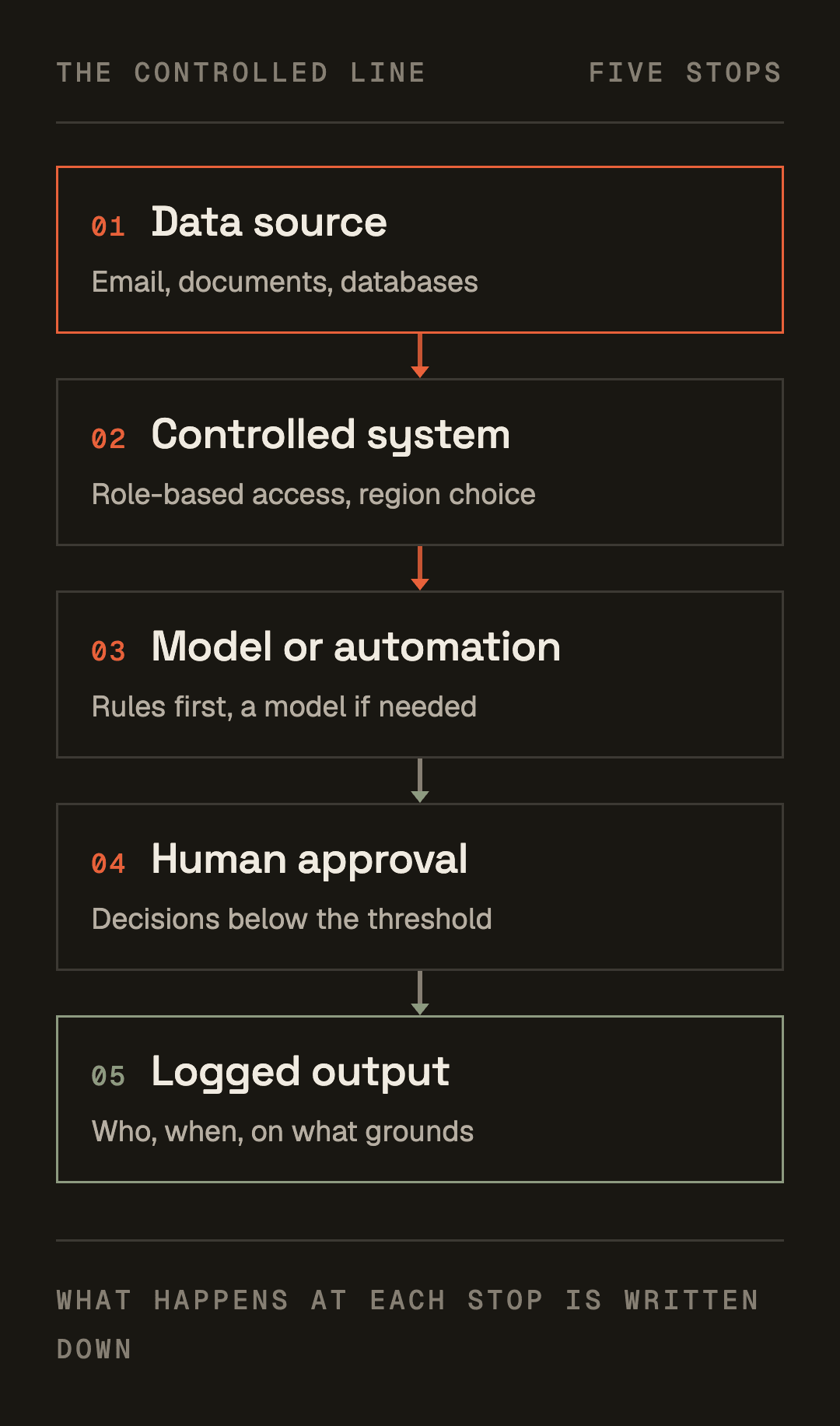
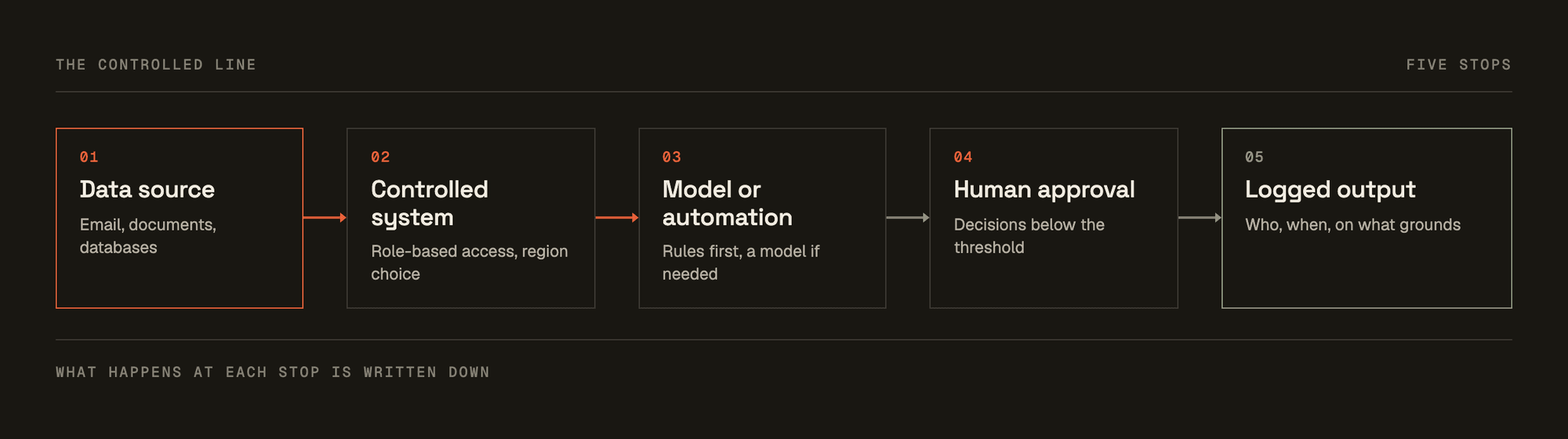
Where each control sits inside the system.
The rule is simple: no step decides on its own and moves on quietly. Where the system cannot be sure, it stops and asks a person.
Three set-ups, one system.
All three run on the same codebase. The choice follows how sensitive the data is and which market the company sells into.
01
Hosting in Türkiye
Production data is stored on Türkiye-based infrastructure. Any external services and data flows are agreed separately for the project.
02
Hosting in an EU region
The system runs in an EU region. This is the default for companies selling into the EU.
03
Deployment on your own server
The system is installed on your hardware, and an open-weight model runs in the same place. Unless an external service is used, data stays inside your network.
Six records you hold at handover.
The proof of compliance is the system itself, not a document. Even so, these six records are handed over in writing for the day an audit asks.
- 01Data and system inventory
- Which data sits where, and which service touches it.
- 02Role and access matrix
- Who sees what, and who can change it.
- 03Action and decision logs
- Which critical action was taken, by whom and when.
- 04Retention and deletion rules
- How long each kind of record is kept.
- 05Backup and restore plan
- Where the backup sits, with the restore tested.
- 06Technical system documentation
- Setup steps and a one-page architecture drawing.
All six are part of the work; none is billed separately.
The four asked before the first call.
Short answers. Anything that needs a legal assessment is a conversation for your lawyer.
In the region you choose: Türkiye, the European Union or your own server. The region is named in the contract and in the deployment records.
No. Training is off on the business APIs and we put that in the contract. If nothing may leave your systems, we run the model on your own infrastructure.
Yes. Every case below the confidence threshold goes to a person, and who looked at it, how long it waited and how it closed are all recorded. We tune the threshold to your cases.
Both stay with you. The repository, the servers and the accounts are in your name from day one, and the inventory, the access matrix and the documentation are handed over with them.
Next step
Let's map the data and compliance requirements of your system.
In twenty minutes we go through where your data sits, who reaches it, and which decisions need a person on them.
- Free · 20 minutes
- You talk to the technical team
- Not legal advice
Laynstack builds the technical compliance infrastructure; the information on this page is not legal advice.