Three services, one team
Software first, then automation of the repetitive work within it.
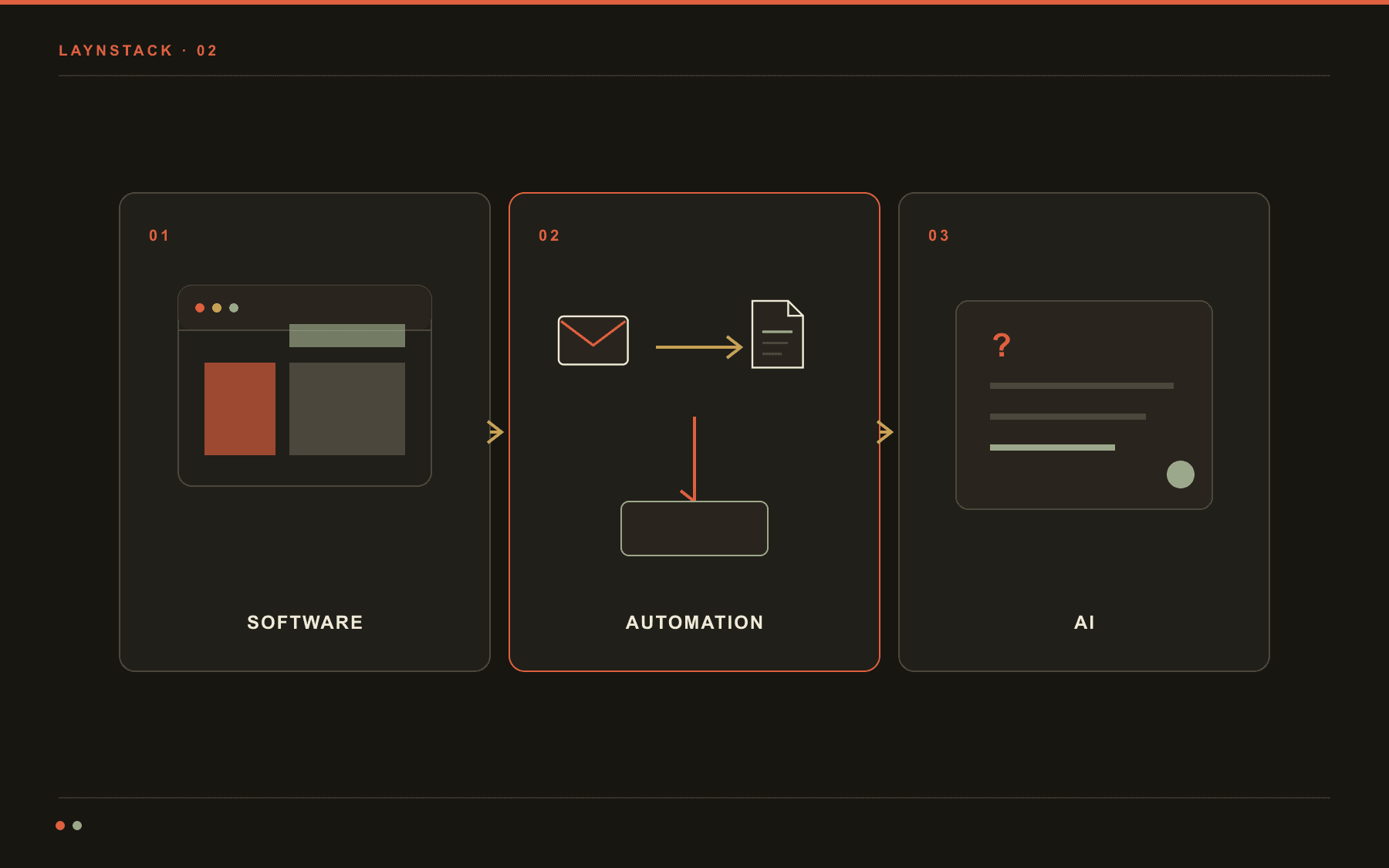
Laynstack is a software studio in Ankara. There are three service lines and the order matters: website, dashboard and internal system development first; then process automation for the work repeated by hand inside that system; then AI integration grounded in your own documents. Most engagements start on the first line.
A company normally buys this from two places. An agency builds the dashboard, and a second firm tries to automate the work inside it afterwards, from the outside. Here both come from the same team, which is the only reason the automation fits the system instead of hanging off the side of it.
- Base
- Ankara · Remote
- First prototype
- 3–5 days
- To production
- 2–6 weeks
- Discovery call
- 20 minutes, free
What holds across all three
- 3–5days
- To a working prototypeOn all three lines the first delivery runs, it is not a deck
- 2–6weeks
- To productionWe cut the scope to fit that window
- 1
- Accountable teamThe same team from first call to handover
- 100%
- Code and data yoursRepository, servers and documentation in your name
- 0
- Sales layerThe technical team doing the work writes the proposal
Software
A working system the business runs on
Automation
Repetitive work handed over to automation
AI
Judgement where rules run out
Websites, Dashboards and Internal Systems
The software your business runs on: from a five-page corporate site, through a dashboard your customers open every day, to an internal system that carries an order from one end to the other. The screen and the data model behind it are written by the same team.
What this covers
- 01Website development: two languages, an editing screen, forms you can measure
- 02Dashboard development: the panel a customer opens to see their own data
- 03Internal tools: an order, an application or a service request tracked end to end
- 04Taking over the spreadsheets and one-off scripts already in use
- 05Data model, role-based permissions and an audit trail
- 06Handover: repository, infrastructure definition and two training sessions
Typical first result
By week six a team runs its daily work in the panel and the spreadsheet stops being the backup. Because the same team built the system, automating the repetitive work inside it later needs no second discovery phase.
Process Automation
Process automation means handing a repeated manual task over to software, end to end. The copy-paste, the retyping, the walk between three screens. The same team built the system, so the flow is written inside it rather than attached to the outside.
What this covers
- 01Incoming documents read and written into the system the moment they land
- 02Workflow automation: approval steps, with exceptions routed to the right person
- 03Moving data between systems: ERP, accounting, CRM, mailbox
- 04Scheduled runs and retries that do not lose work
- 05A record of every run: who, when, on which input
- 06A control screen, failure alerts and a manual re-run
Typical first result
One flow live in the first month: around forty documents a day, thirty-seven finishing untouched, three queued with a written reason. Those proportions are illustrative; yours get measured on your own work in the first week.
AI Integration
AI integration means putting a model on top of your own documents, records and correspondence. Not a general chat box: an assistant whose limits are written down before it goes anywhere near a customer.
What this covers
- 01Question answering over your own archive, with the source under every answer
- 02Document reading: invoices, delivery notes, contracts, application forms
- 03Email and ticket triage with drafted replies
- 04Called from inside the panel we build, or the software you already run
- 05Model comparison: score, latency and monthly cost side by side
- 06An evaluation set and a bar to ship against
Typical first result
By the end of week three: an assistant that answers fifty real questions from your own archive with citations, and says so when it does not know.
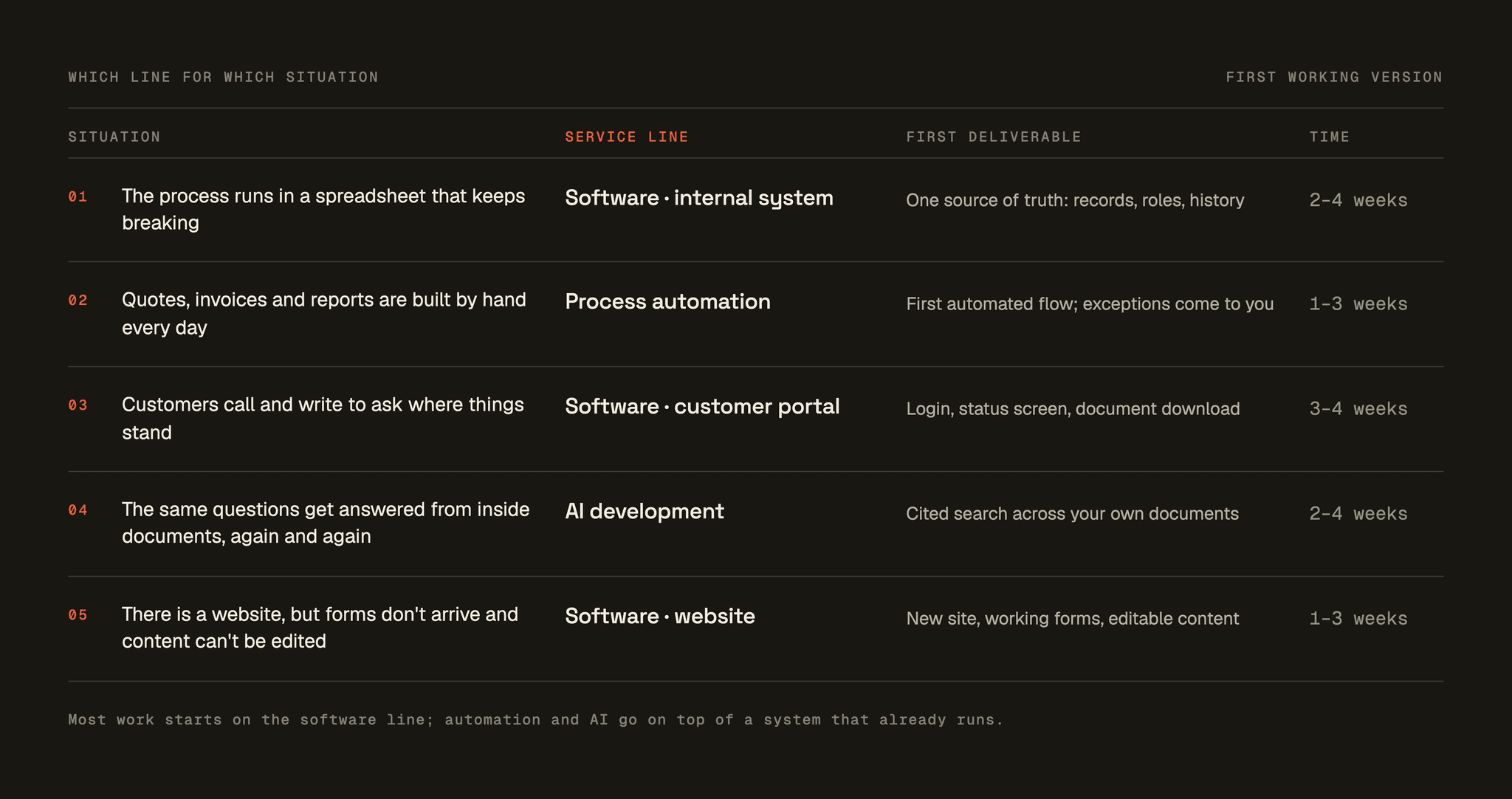
Choosing which line to start on.
The three services can be taken separately or in sequence. These six questions come up most often on a first call.
The order is usually this. If no system runs your business yet, start with the software. If a system exists and manual work piles up inside it every week, automation is the conversation.
AI comes up only when work is left that rules cannot settle, where the input is genuinely open-ended. Projects that start from the other end tend to stall, because nobody settled what should be automated.
Yes. The three are not a package. Most of the work that arrives starts on one line and finishes there. A second line is discussed only after the first is live, and only if it is actually needed.
Yes. Brand identity, ad management and content production are not our work anyway; we sit beside the agency that does them. On the technical side what matters is that the split is written down: who holds which repository, who keeps which system up, and who gets the message when something breaks.
We will look before we promise. A short review comes first: where the code lives, how it starts up, what state the database is in. If the review says taking it over is not the right move for you, we say so.
Yes, that is what the first call is for. Twenty minutes to go through what the work is, where it stalls, and whether software is genuinely the answer. If we think it is not, you hear that on the first call, and there is no charge for it.
With a twenty-minute conversation. After it the scope goes onto one page, a time range is given, and a fixed figure comes back for the prototype. The production price is only fixed once the prototype is finished, because that is the point where both sides can see how large the work actually is.
Next step
Let's talk about what to build, or what to automate.
A free twenty-minute call. You will be talking directly to the technical team doing the work, not a salesperson. Bring a site, a dashboard, or a task your team repeats every week – if it is not worth building, we say so.
- Free · 20 minutes
- Directly with the technical team
- Reply within 1 working day